
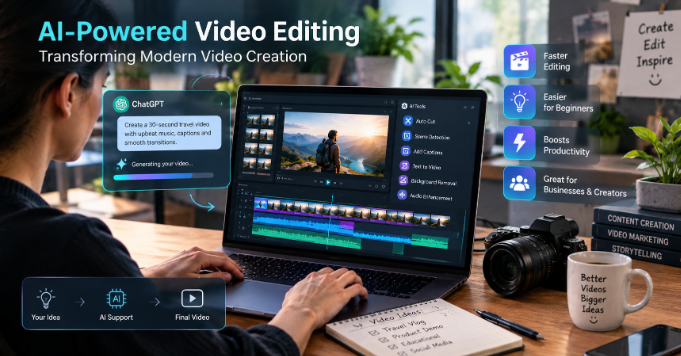
In the past, creating good video content required a lot of time, money, as well as knowledge of technical skills. Thanks to artificial intelligence, the whole process is changing. Thanks to AI-powered tools, which assist people at every stage of video creation, making films is no longer complicated. For creators exploring smarter workflows, a ChatGPT video editor can also help connect natural-language instructions with modern video creation and editing processes. This transition is advantageous for content creators, marketers, educators, companies, and social media specialists who look for captivating videos and do not wish to devote excessive time to complex editing processes. The recent improvement of AI technology allows intelligent video tools to play a vital role in content creation and distribution nowadays.
How Artificial Intelligence Is Changing Video Production
Conventional video editing has multiple phases. This comprises cutting the video, arranging the videos, adding transitions, editing the audio, and adding special effects. Even though these methods are still essential, the employment of artificial intelligence has simplified many repetitive aspects of video editing.
Nowadays, modern video technology can analyze the content, distinguish images, and help with the editing process. Hence, the creator can devote more time to developing their ideas instead of working on technical distractions.
Artificial Intelligence can also prove to be quite useful in dealing with a lot of video data. For example, smart systems can identify useful materials, recognize voices, and help with subtitles.
AI Tools Make Creative Work More Accessible
One of the major pros of AI video technology is that it is accessible. This means beginners may find it hard to work with professional editing programs because they often come with many different controls and possibilities. AI-enabled tools can make the technology much easier and more accessible for users.
At the same time, more seasoned video editors may use AI technology to make certain processes faster. Rather than taking away their skill, AI can accompany editors’ activities and help make the work process more organized and productive in terms of content production. This method is particularly useful for people who work on short video production, education, commercials, tutorials, and social media posts regularly, as they will spend less time creating and more time being creative and producing other content.
The Role of Natural Language in Video Editing
One more significant evolution is the increasing links connecting natural language to creative software. Rather than depending only on menus and technical controls, users increasingly express their demands in plain English.
This principle makes video production simpler. The producer might wish to trim a particular sequence, set the pace correctly, write captions, or make additional visuals. AI systems can understand such instructions and help execute all the necessary production actions.
A ChatGPT video editor symbolizes the transition to conversational and AI-powered video methods wherein conversational language comes into play in the work of art. Thus, there is no need for users to learn all technical aspects; AI can help with the implementation of their ideas.
Improving Efficiency Without Losing Creativity
While efficiency is important, effective video content production still revolves around human creativity. If a creator can get some suggestions or speed up tedious processes using AI, in the end, it is still up to the creator to choose the most effective way to deliver an idea.
For instance, an AI can write a project draft, but the creative person can finish it with a signature tone, pace, images, and storytelling style. The combination of the two approaches promotes a proper balance in production. Automation speeds up the process while human instinct regulates the major decisions. Besides, speed in editing enhances the scope for experiments. Since all conversations can be made much quicker, creators try various formats, sequences, and captions, and do not need to recreate everything from scratch.
AI Video Creation for Businesses and Content Teams
AI in video production. Marketing teams often have to make several copies of a certain content for many different formats. Doing this manually can drain valuable resources.
AI can come in handy for streamlining several work tasks, such as text writing, subtitle writing, visual correction, or content programming. Thus, even a small marketing team can generate much content without losing any continuity in branding.
The speed of doing business is a vital factor in social media marketing. Trends change at a fast pace, making audiences demand innovative and relevant content. Therefore, through cutting-edge AI technology, businesses can respond to changes in the environment promptly and without delay.
The Importance of Human Oversight
Although automated video content offers various benefits, there should always be a thorough review following its production. This is because, in some cases, the use of machines can go wrong, for example, by misreading an instruction or not taking crucial contextual information into account. Therefore, the human evaluation of the outcome should take place in any case.
It is highly significant for all those who deal with videos containing factual information, teaching content, brand messages, as well as sensitive information to double-check all the video components, including text, images, audio, and statements made.
Moreover, one should keep in mind the importance of originality in AI-generated content. Machines should be used only as assistants in the process of creation, but not to promote any repetitive content.
The Future of AI-Assisted Video Production
It can be anticipated that the integration of AI into everyday video workflows is likely to increase. Future solutions can bring more precise assistance in editing, better understanding of content, personalization, and seamless collaboration among different creative tools. However, combining technology with the creative process will remain the most effective way forward in the given situation. AI is able to make video production less technically demanding and faster, while people are necessary for storytelling, decision-making, the emotional component, and the creativity of the content.
Conclusion
The emergence of AI-backed video creation technology has revolutionized the world of digital multimedia content. By taking care of repetitive activities, allowing natural language to be used in processing video, and improving the quality of production, advanced video editing tools have eased the process of professional video editing. However, the technology performs better when people stay engaged in video production development. Guidance from human representatives is vital to the creation of authentic and appealing videos. The evolution of AI shows that in the future, video production will not be about labor-saving processes; specialized software will equip video creators with more effective instruments instead.
 Donnalyn Nelsonelsic is the kind of writer who genuinely cannot publish something without checking it twice. Maybe three times. They came to expert perspectives through years of hands-on work rather than theory, which means the things they writes about — Expert Perspectives, Market Analysis Trends, Entrepreneurship Tips, among other areas — are things they has actually tested, questioned, and revised opinions on more than once.
That shows in the work. Donnalyn's pieces tend to go a level deeper than most. Not in a way that becomes unreadable, but in a way that makes you realize you'd been missing something important. They has a habit of finding the detail that everybody else glosses over and making it the center of the story — which sounds simple, but takes a rare combination of curiosity and patience to pull off consistently. The writing never feels rushed. It feels like someone who sat with the subject long enough to actually understand it.
Outside of specific topics, what Donnalyn cares about most is whether the reader walks away with something useful. Not impressed. Not entertained. Useful. That's a harder bar to clear than it sounds, and they clears it more often than not — which is why readers tend to remember Donnalyn's articles long after they've forgotten the headline.
Donnalyn Nelsonelsic is the kind of writer who genuinely cannot publish something without checking it twice. Maybe three times. They came to expert perspectives through years of hands-on work rather than theory, which means the things they writes about — Expert Perspectives, Market Analysis Trends, Entrepreneurship Tips, among other areas — are things they has actually tested, questioned, and revised opinions on more than once.
That shows in the work. Donnalyn's pieces tend to go a level deeper than most. Not in a way that becomes unreadable, but in a way that makes you realize you'd been missing something important. They has a habit of finding the detail that everybody else glosses over and making it the center of the story — which sounds simple, but takes a rare combination of curiosity and patience to pull off consistently. The writing never feels rushed. It feels like someone who sat with the subject long enough to actually understand it.
Outside of specific topics, what Donnalyn cares about most is whether the reader walks away with something useful. Not impressed. Not entertained. Useful. That's a harder bar to clear than it sounds, and they clears it more often than not — which is why readers tend to remember Donnalyn's articles long after they've forgotten the headline.